
The short version
- One contact, usually a board member or the manager, sends the request and approves the scope.
- List shared spaces only: lobbies, corridors, mail areas, shared restrooms and amenity rooms. The program never goes inside units.
- Give each space its own frequency instead of one schedule for the whole building.
- Settle restroom consumables and how issues are reported before the walkthrough.
Decide who sends the request
Shared spaces belong to whoever answers for the building as a whole. In a condominium or townhome community that is usually the association’s board, often acting through a management company; in a rental building it is the owner or the property manager. The request should come from that side, not from an individual resident.
Name one contact. That person answers questions during the quote, arranges the walkthrough, approves the written scope and receives reports afterward. A board whose members change each year can name a role, such as the community manager, so the contact does not disappear after an election.
List the shared spaces, and stop at the unit door
Walk the property with a notepad before writing anything else. For each space, note what it is, its floor type and roughly how big it is. A list for a condo or apartment building might include:
- Lobbies and entrances. Entry mats, hard floors, seating, the inside of the entry glass and any front desk.
- Corridors and stairwells. Carpet or hard flooring on each level, handrails, door kick plates and light switches.
- Mail and parcel areas. Counters, the face of the mailbox bank, parcel shelving and the floor beneath it.
- Shared restrooms. Count the toilets, urinals and sinks in each; the fixture count tells us more than the room size.
- Amenity rooms. A clubroom, fitness room, business center or party room, including any kitchenette.
The list ends at every unit door. A common-area program never goes inside a unit, occupied or vacant. Some work is outside it too: pressure washing breezeways and pool decks, exterior window washing, carpet shampooing or steam cleaning, and stripping or waxing hard floors are not services we offer. Leave those off the request, or mark them as another vendor’s job.
How often each space needs a visit
A single schedule for the whole building tends to overserve quiet spaces and underserve busy ones. Give each space its own frequency instead. Recurring commercial programs can run from once a month up to every weekday, and the spaces inside one program do not all need the same rhythm.
Think about how each space is really used:
- Entrances and mail areas carry traffic every day and show it first, especially after rain.
- Restrooms next to a pool or clubroom are busiest around events and through the summer.
- Upper-floor corridors and back stairwells may need far less attention than the ground floor.
- A party room that is booked now and then may need fewer visits than the lobby beside it.
Write a first guess beside each space. The walkthrough is the place to test those guesses, and the schedule can be revisited once the board has seen a few visits.
Access and residents’ hours
Residents keep using lobbies, halls and mail areas while they are being cleaned, so the request should say when the building is quietest and when it is busiest. The manager or board knows this best: the morning rush to the parking lot, evening parcel pickups, weekend events in the clubroom. Mention any quiet hours residents already observe.
Then describe how a crew gets in and moves around:
- How the crew enters: fob, key, door code or a check-in at a front desk.
- Which doors and rooms stay locked, and who opens a storage or janitor closet if supplies live there.
- Where a vendor can park and unload equipment.
- How residents will hear about cleaning days and wet floors. That notice comes from the board or manager, not from the crew.
If the crew cannot get into the property at the scheduled time, the visit is treated as a late cancellation, so test fobs and codes before the first visit.
Who supplies restroom consumables
The crew brings the supplies and equipment, eco-friendly products included. Consumables are a separate matter. Toilet tissue, paper towels, hand soap and bin liners for shared restrooms are bought by the building, and restocking dispensers from that supply is part of the routine work when it is written into the scope. The request should say:
- Who orders consumables, and from whom.
- Where the stock is kept, and whether that room is locked.
- Whether restocking dispensers is part of every visit.
- Who the crew tells when stock is running low.
Without these answers, a restroom can be cleaned on schedule and still run out of soap, because each side assumed the other was watching the shelf.
How residents and the board report issues
The crew works to the building’s written scope, not to requests made in the hallway. Residents with a concern take it to the manager or board, who decide whether it is a cleaning matter and pass it on. One channel keeps one list, and one person answerable for changes to it.
For the board’s own checks, photo confirmation is available after a cleaning, which helps a manager who looks after several communities. Say in the request who receives those photos and who will inspect the shared spaces after the first few visits.
Why the program is quoted after a walkthrough
We publish no per-visit rate for common areas. A building with one lobby and a mail room needs a different program from one with corridors on five floors, a fitness room and three shared restrooms, even when the square footage is similar. Offices are priced by facility type, floor-area band and visit frequency, as the commercial price table shows, but common-area programs are quoted after a walkthrough.
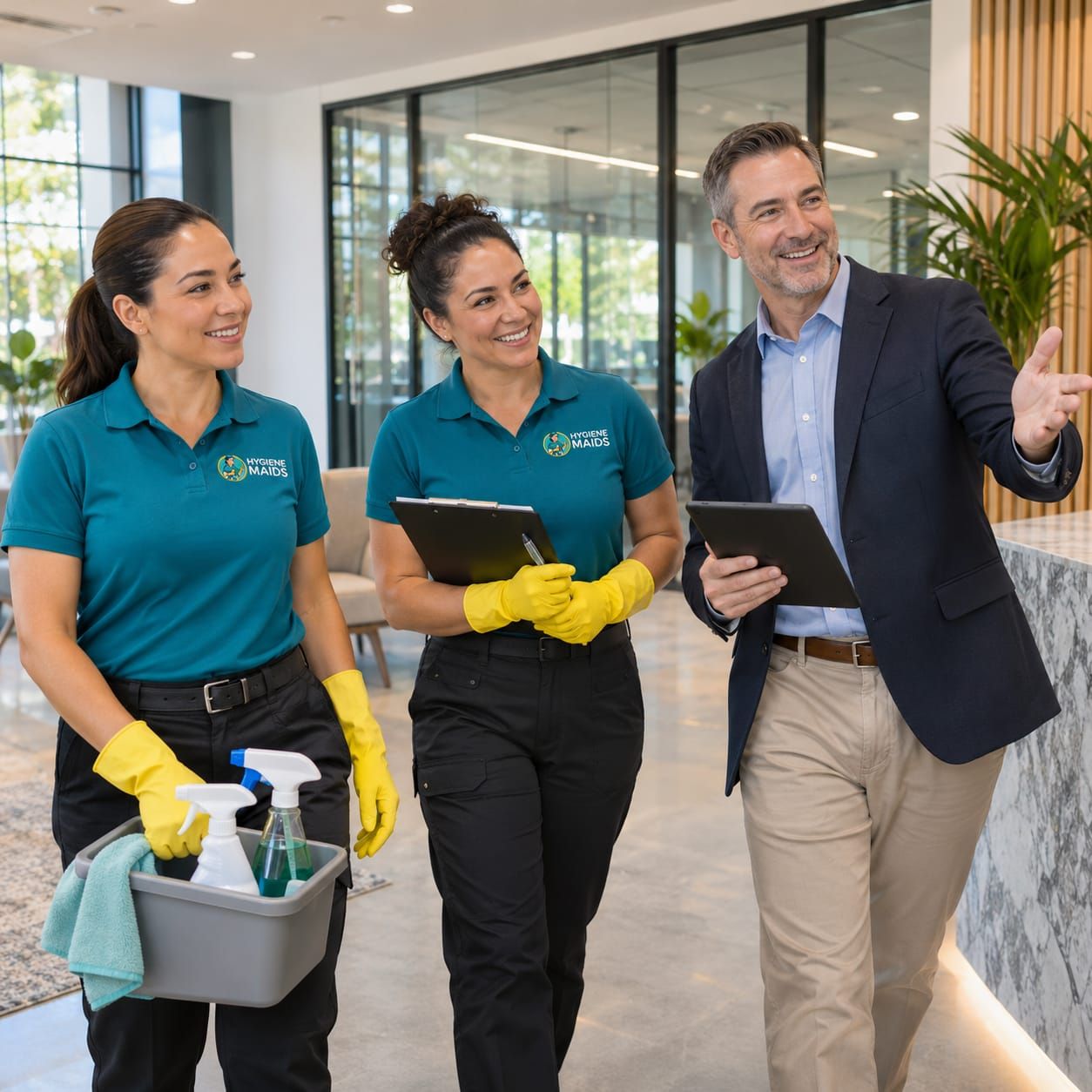
During the walkthrough your contact shows us each shared space, and we note floor finishes, busy spots, locked doors, the trash route and parking. The free quote that follows is a written scope: each space with its frequency, how the crew gets in, who supplies consumables, and the price. To start, request a free quote with the address, your list of spaces and the contact’s name, or call (346) 586-2912. Each address is confirmed first, and buildings in Sugar Land, Stafford, Missouri City, Meadows Place, Richmond and Rosenberg can be quoted. The common area cleaning page shows the full scope.